


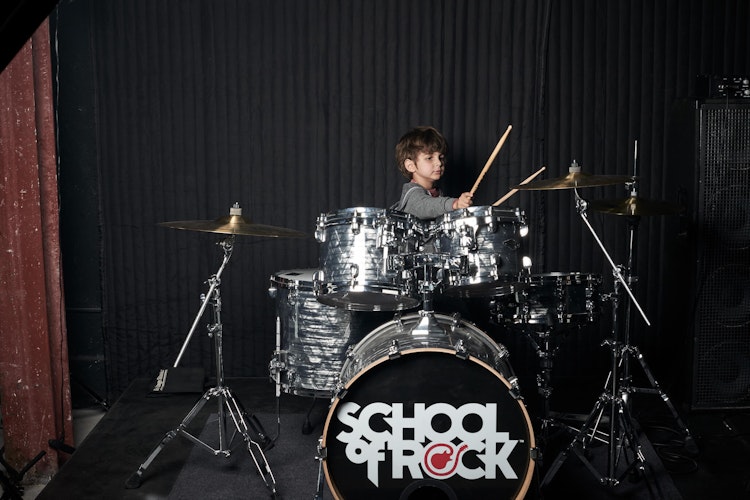
Quick Answer: The best age to start drum lessons is typically 6–7 years old because most children have developed the focus, coordination, counting skills, and discipline needed for structured instruction. However, children as young as 4–5 can begin learning rhythm fundamentals, while teens and adults can successfully start at any age.
Does your child constantly drum on household objects like tabletops or pots and pans? Do they like to make noise using whatever they have within their reach? Congratulations: you just might have a drummer in the family!
There is a drummer inside almost every one of us, just waiting for the chance to arise after only a few drum lessons. The drums are one of the most universal instruments found throughout the world and are used for a variety of purposes in many different cultures.
Still, many parents wonder: how do you know when a child is ready for drum lessons? Here at School of Rock, our instructors can help you decide the best age for beginning drum lessons that are geared for both kids and adults.


WHAT IS THE BEST AGE TO LEARN DRUMS?
The best age to start drum lessons is generally between ages 6 and 7, as this is the age when most students gain the mental focus needed to learn an instrument. Even so, while ages 6 to 7 are considered the best age for beginning drum lessons there are always exceptions, and it ultimately comes down to your child's willingness to learn.
The best age to start drum lessons is between 6 and 7, but there are always exceptions.
DRUM LESSON READINESS BY AGE
Is your child ready to start drum lessons?
For the beginning musician, the drums are one of the easiest instruments to pick up and are an ideal instrument for students of all ages. Still, all students are unique, and progress at their own pace. Before placing your child into drum lessons for kids, it’s important to prepare them for what they'll need to learn.
Concepts like rhythm or timing are important music skills when learning the drums, and younger children in particular can benefit from the positive effects of music on cognitive development. These effects will have a positive impact on growth and learning in other activities. This is especially true when beginning drum lessons are taught in a focused music program that combines group practice with one-on-one instruction.
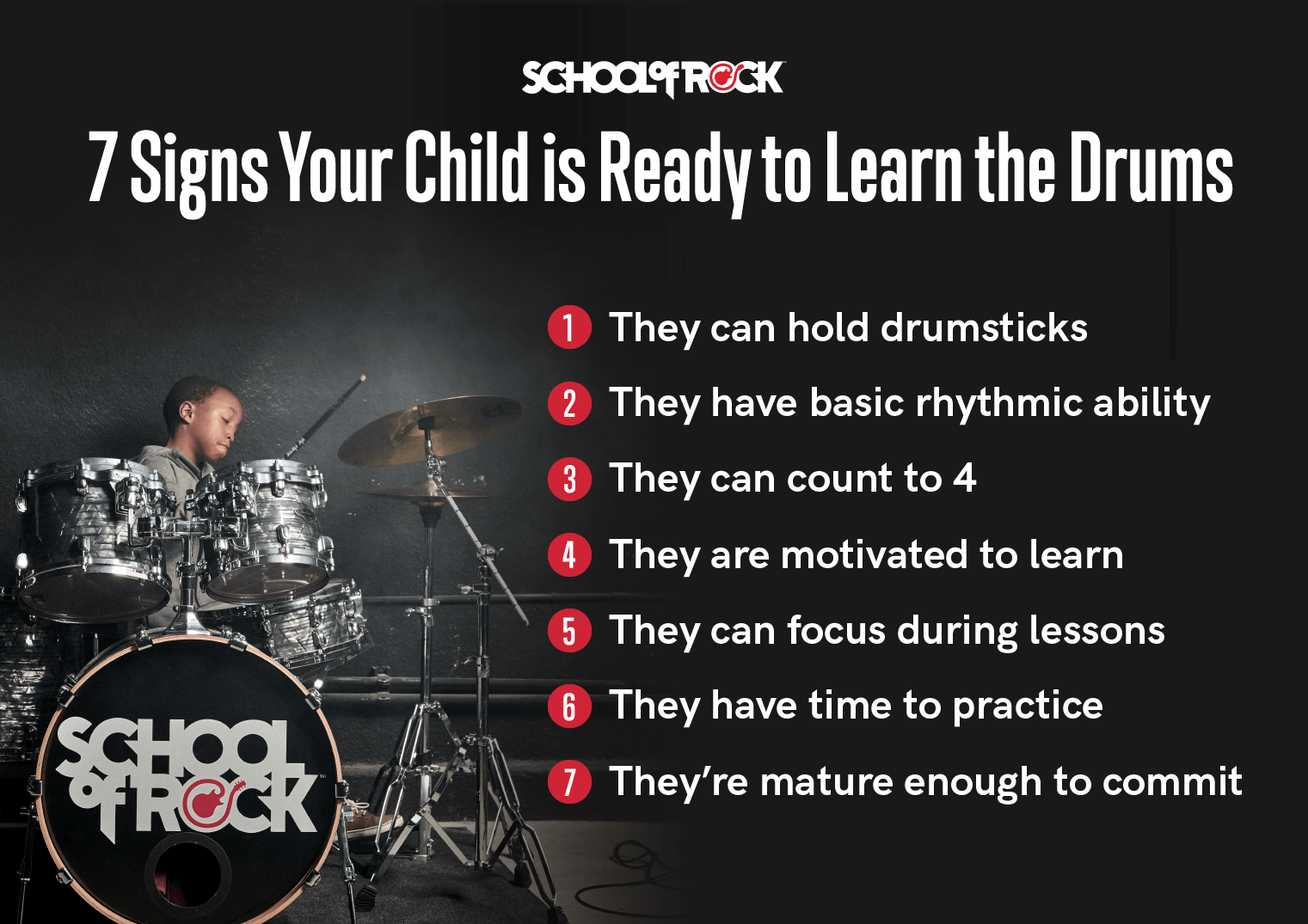
7 SIGNS YOUR CHILD IS READY FOR DRUM LESSONS:
- Your child can comfortably hold the sticks. Children may get frustrated in beginning drum lessons if the sticks are too big for their hands. If the drumsticks are too big, consider hand percussion instead.
- Your child has a basic rhythmic ability. If you notice your child can keep rhythm as they dance or play along to songs, then they have the basic rhythmic ability needed to learn an instrument. Programs like the Little Wing music program are focused on teaching younger kids these skills and feature many different drum lessons.
- Your child can count to 4. When taking drum lessons, it’s important to understand drum notation – which uses timing and basic counting skills.
- Your child is motivated to learn. If your child expresses interest in wanting to play the drums, then they probably are ready to take the next step.
- Your child has the focus needed for lessons. Most drum lessons are between 30-45 minutes long. Children who cannot hold focus for this amount of time may not be ready to begin lessons.
- Your child has time in their daily routines to practice. Regular practice is essential for learning any instrument. Children with no time to practice drumming will not see results and become frustrated. Our experts recommend students practice their beginning drum lessons for at least 30 minutes every day.
- Your child is mature enough to commit. To start playing the drums, a student must be mature enough to take on the commitment of learning an instrument, respect their peers, and practice consistently.
SIGNS YOUR CHILD IS READY VS NOT READY
Play the drums in real performances
Our music programs and drum lessons for kids are taught by practicing drummers with the experience you need to learn to play. Perform live shows and develop your drum skills in a supportive learning environment for all skill levels.
Learn to play
6 TIPS WHEN STARTING THE DRUMS
When learning the drums, there are some tips that will help make the journey successful.
- Look at drum size. To start, the drums should be set up to fit the student’s size.
- Get a properly-sized drum throne. The drum throne should be at a comfortable height and all drums should be in easy reach.
- Focus on the basics first. In beginning drum lessons, students should focus on getting the basics down as opposed to just playing fast.
- Use practice pads for quiet study. Practice pads, along with low-volume cymbals and drumheads, will help keep the sound levels manageable, especially around the house.
- Protect your ears. Hearing protection is important with drumming, and there are many different levels of hearing protection available depending on the needs of your child.
- Learn with other students. Playing with other new drummers is a great way to quickly improve on the instrument. School of Rock offers unique opportunities for young students to play together in a band as part of a fun learning environment.
Pro tip: Buying your kid's first drum set
If you’re looking for your kid's first drum set, check out our buying guide for tips on finding the best drums for a beginner, so you can get to playing as soon as possible.
Check out our "Guide to Buying Your First Drum Set"
Beginning Drum Lesson FAQs
Is it ever too late to start drums?
Absolutely not! While we recommend that drummers start studying at ages 6 to 7, kids shouldn’t have all the fun. It’s never too late to pick up the drums or nurture your inner rock star. In fact, the School of Rock Adult Program sees many adult students succeed in their drum lessons every day.
Can a 5-year-old learn drums?
Yes. Many 5-year-olds can begin learning basic drumming skills, especially if they show an interest in music, can follow simple instructions, and keep a steady beat. Lessons for younger children should focus on fun, rhythm, and musical exploration rather than advanced technique.
Is it easier to learn drums as a child or an adult?
Both children and adults can successfully learn to play the drums. Children often benefit from early exposure to rhythm and music education, while adults may progress quickly because they can focus longer, practice independently, and understand musical concepts more easily.
What skills do children learn from drum lessons?
Drum lessons can help children develop rhythm, timing, coordination, listening, concentration, discipline, and confidence. Learning music may also support cognitive development and encourage creative self-expression.
Do children need their own drum set before starting lessons?
No. Beginners can often start with practice pads, electronic drum kits, or by taking lessons at a music school that provides equipment. As interest and commitment grow, parents can decide whether setting up a drum set at home is a good investment.
Can teenagers start learning drums for the first time?
Absolutely. Teenagers often have the physical coordination, focus, and motivation needed to learn quickly. Many successful drummers started later in childhood or during their teenage years.
Are drum lessons good for children with lots of energy?
Drumming can be an excellent activity for energetic children. It provides a creative outlet, encourages movement, improves focus, and helps students channel their energy into developing musical skills.
How long does it take to learn the drums?
Every student progresses at a different pace. Many beginners can learn basic rhythms and simple songs for beginners within a few months of consistent practice, while advanced drumming skills may take years of dedicated study and performance experience to develop.
What are the benefits of group drum lessons versus private lessons?
Private lessons provide individualized instruction and personalized feedback, while group lessons allow students to develop ensemble skills, learn from peers, and gain experience playing with other musicians. Many students benefit from a combination of both.
What should beginners practice first when learning drums?
New drummers typically start with fundamental skills such as keeping a steady beat, basic rhythms, notation, timing exercises, stick control, and simple drum patterns to build a strong foundation.
Are drums harder than piano or guitar?
No instrument is inherently harder than another; they just present different challenges. Many beginners find drums easier to start because students can learn basic rhythms and play along to songs relatively quickly. However, becoming an advanced drummer requires strong coordination, timing, independence between hands and feet, and musical awareness. Piano and guitar involve different skills, such as learning notes, chords, and melodies. The best instrument is often the one that keeps a student motivated to practice and learn.
How often should beginners practice drums?
Consistency is more important than long practice sessions. Beginners typically benefit from practicing several times per week, even if sessions are relatively short. Regular practice helps students develop rhythm, coordination, muscle memory, and confidence. Establishing a routine and focusing on fundamental skills such as timing, stick control, and basic beats can help new drummers make steady progress.
Are electronic drums better for beginners?
There are many different types of drums and each offers a unique experience. Electronic drums can be an excellent option for beginners, especially for families concerned about noise levels. They allow students to practice with headphones, take up less space than many acoustic kits, and often include built-in practice tools, metronomes, backing tracks, and learning features. While acoustic drums provide a more traditional feel and dynamic playing experience, electronic kits offer convenience and flexibility that can make practicing easier for many new drummers.
To improve expertise and authority signals, it would be beneficial to add a ‘reviewed by’ byline, which would include an expert/instructor name, years teaching drums, performance background, and an article updated date.
Here is an example: Reviewed by John Smith, Drum Instructor with 12+ years teaching beginner and intermediate drummers.