


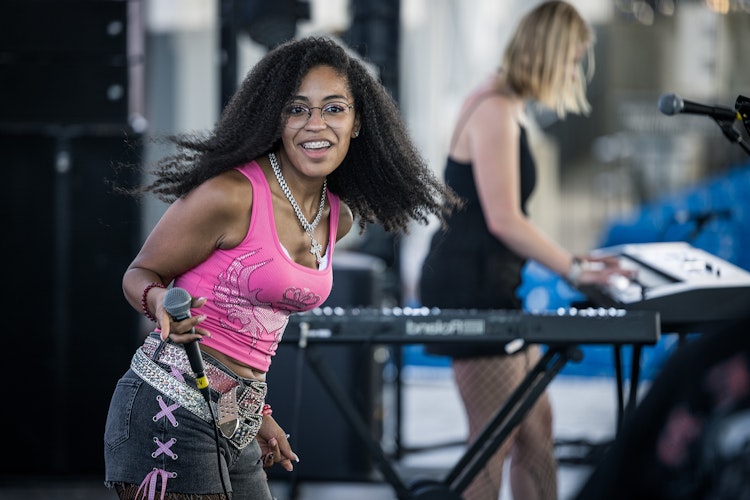
Joe Howard, School of Rock GearSelect and Merchandise Category Manager, writes a thought-provoking and insightful look at how the history of music is Black history, connecting the dots through musical history back to the roots. Through the following article, Joe shows us, in his own words, that most of the music School of Rock teaches wouldn’t exist if the people who built it weren’t there to show us how it works.
Rock is not a finished story. It’s a living language.
It started in Black communities, moved through blues, gospel, jazz, rhythm and blues, and it kept evolving as it passed hand to hand. Every riff, groove, lyric, performance choice we teach lives inside that continuum. Jimi Hendrix said it best: "I started learning the blues before I knew what it was. That’s where my music came from. That’s where all rock music came from."
It hits differently now because we are losing some of those elders. Not just musicians, but primary sources. People whose phrasing, groove, emotional intelligence, and songwriting shaped everything, from British rock to funk, hip-hop, and modern R&B.
In 2025, we lost Roberta Flack, Sly Stone, Roy Ayers, Sam Moore, Angie Stone, D’Wayne Wiggins, Carl Carlton, Don Bryant, and others. They were not side chapters in music history; they were connective tissue. Their work did not just influence music. It defined the vocabulary we still use today.
Eric Clapton once said, "I would have never been able to play the way I play if it hadn’t been for the Black artists I listened to as a kid. Muddy Waters, Robert Johnson, B.B. King."
When he was asked how it felt to be the greatest guitar player, he said, "I don’t know, ask Prince."
Every note, every beat, every texture on those records is lineage in motion.
Black music evolves, borrows, and innovates across generations
D’Angelo was one of my top ten favorite artists of all time. His passing in 2025 hit me hard. He was a master of groove and soul. He carried forward the revolutionary energy of Sly Stone and the stylistic boldness of Prince. He absorbed the funk, rhythm, and musicality of Sly Stone. He blended that with the layering, harmonic sophistication, and the cool, enigmatic mystique that Prince perfected.
Here’s the thing. D’Angelo’s approach mirrored their genius and their reclusive focus. When he was composing Voodoo, he would study tapes, listen obsessively to Prince, Sly Stone, and other masters, then hit record and jam with his band late into the night. The way he rehearsed his musicians? Directly out of Prince’s playbook, precision, feel, freedom all in one. The albums Brown Sugar, Black Messiah, and especially Voodoo are living classrooms.
Every note, every beat, every texture on those records is lineage in motion. This is how young folks learn that Black music evolves, borrows, and innovates across generations. D’Angelo didn’t just play music. He embodied the lineage. He made it fresh, intimate, electrifying.
And if anyone doubts the reach of that lineage, look at the tribute at the 2026 Grammys. Seeing artists like Bilal and Lauryn Hill come together to honor him is proof of the lasting impact he had on Neo-Soul and Black music as a whole. D’Angelo didn’t just influence a sound; he shaped a way of thinking about groove, restraint, vulnerability, and truth in music. He embodied the lineage, and he passed it forward in a way that will keep teaching long after he’s gone.
Bob Dylan didn’t invent narrative songwriting. He studied it. "All my songs were built on the shoulders of Black music, blues, folk, gospel. Every chord I played was borrowed and reshaped," he said. Bruce Springsteen didn’t invent communal rock performance. He absorbed it from soul, gospel, and rhythm and blues.
The British Invasion? They didn’t create a new musical language. They learned one and amplified it. Paul McCartney said about Little Richard, "I wouldn’t have written songs the way I did without Little Richard. I listened, I copied, I learned. It was the heartbeat of everything I did."
Hip-hop didn’t break from rock’s roots. It carried the same tools forward: rhythm, repetition, storytelling, resistance. Questlove said, "Hip-hop isn’t new. It’s the same Black music that taught Chuck Berry to play guitar. It’s the same music that made Little Richard scream. It’s passed from hand to hand."


We teach history to bring the music to life
Stevie Wonder reminds us why this lineage matters: "The music of Black America is about feeling as much as notes. If you lose that feeling, you lose the soul of the song."
Chuck Berry put it even more directly, saying "Rock and roll is rhythm and blues with a different name. Take away the blues, there is no rock."
Etta James added, "We sang it so you could hear it in a different way. The songs, the feeling, the soul, that’s what passes on, not just the words."
Gil Scott-Heron said it best: "The music doesn’t start or stop with me. It’s a conversation that started long before I was born and will go on long after I’m gone."
We don’t teach music to put on shows. We put on shows to teach music.
We don’t teach history to memorize facts. We teach history to bring the music to life.
It’s about teaching young folks to listen. To hear lineage. To understand why a groove feels right, why a lyric hits, and why this music still matters.
"The music doesn’t start or stop with me. It’s a conversation that started long before I was born and will go on long after I’m gone."
Black History Month is not about checking a box; it’s about stewardship. It’s about telling the story correctly while we still can, making sure the next generation doesn’t inherit a simplified version of something this rich.
The playlist below is not a greatest-hits list. It is evidence.
Rock is not owned by any one moment or movement. It’s shared. Knowing where it comes from is how we keep it alive.

About the Author
Joe Howard serves as Category Manager of GearSelect and Merchandise at School of Rock, connecting gear, curriculum, and performance-based learning to support student success. As a professional musician, producer, and music educator, he believes understanding the cultural foundations of modern music deepens both performance and appreciation.