


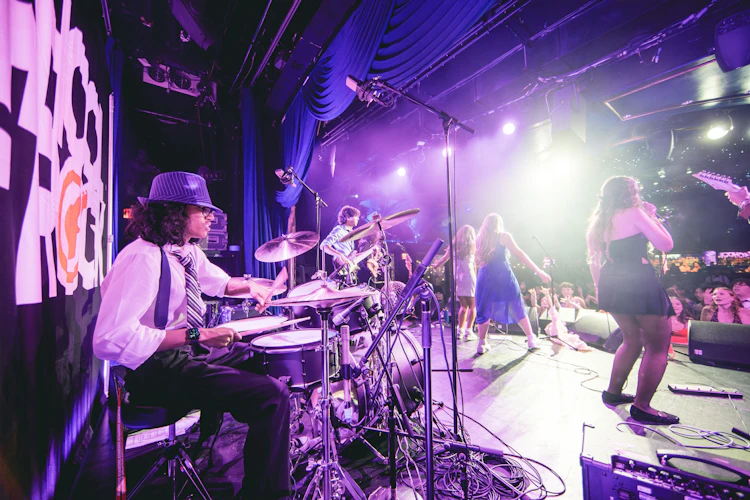
Despite springing from the shared roots of the Blues, Jazz, and Rock remained quite separate for much of the mid-20th century. Jazz was challenging, complex, improvisational, and increasingly experimental. Rock was rebellious, built on heavy backbeats, loud amplifiers, and raw energy. However, by the late 1960s, these two genres were beginning to blend in a new movement, Jazz fusion, that redefined the boundaries of modern music.
The Roots of Rock
To understand the connection between these two genres, one must look at how Rock evolved from its rhythmic roots into a complex medium capable of absorbing Jazz’s sophistication. Rock emerged in the 1950s primarily as a fusion of Rhythm and Blues and Country music, characterized by its reliance on the backbeat and the electric guitar. While early Rock and Roll was structurally simple, focusing on the I-IV-V progression, the genre underwent a massive expansion in the mid-1960s as musicians sought to elevate the form beyond three-minute radio singles.
As the 1960s progressed, Rock musicians began to prioritize instrumental prowess and sonic experimentation. This era saw performers like Jimi Hendrix moving away from traditional Pop song structures in favor of extended soloing. These adventurous artists were not merely playing louder; they were exploring tonal colors through feedback, distortion, and wah-wah pedals, which mirrored the way Jazz soloists used their instruments to mimic the human voice. This emphasis on the instrumental voice became the primary bridge that allowed Rock musicians to communicate with Jazz veterans.

The Beginnings of Jazz Fusion
Jazz legend Miles Davis forged the most significant bridge between these worlds. Influenced by the Funk of James Brown and the Psychedelic Rock of Jimi Hendrix, Davis traded his acoustic trumpet for electric effects and added Rock-style instrumentation. This marked a definitive shift away from standard "swing" rhythms toward the straight-eighth note feel common in Rock and R&B. His 1970 album Bitches Brew utilized electric pianos, distorted guitars, and dense, Rock-influenced percussion, proving that Jazz could be loud and visceral without losing its improvisational soul.
Finding Common Ground
While the attitude of the genres differed, they shared a core DNA of instrumental mastery. Rock bands like Cream and The Jimi Hendrix Experience began incorporating long, improvisational jams that mirrored the soloing structures of Jazz. Rock artists began looking toward Jazz for complex chord voicings.
Following the lead of Miles Davis, several alumni from his bands formed the definitive fusion groups of the 1970s. These ensembles blended the technical depth of Jazz with the stadium-filling power of rock. The Mahavishnu Orchestra, led by John McLaughlin, introduced high-gain guitar shredding to complex time signatures. Return to Forever, fronted by Chick Corea, leaned heavily into synthesizers and rock-centric riffs. Meanwhile, Weather Report utilized the fretless bass virtuosity of Jaco Pastorius to bridge the gap between avant-garde jazz and pop-adjacent melodies.
The technical development of rock also saw the introduction of the power trio format, typically guitar, bass, and drums. This stripped-down arrangement forced each musician to play with greater density and harmonic responsibility. In this environment, rock drummers began to move away from simple time-keeping, adopting the busy, polyrhythmic styles of jazz drummers like Elvin Jones. This increased rhythmic complexity made it possible for rock to support the complex improvisations typically reserved for Jazz.
Legacy and Modern Influence
The connection between the two genres did not stop in the 1970s. The influence became cyclical, giving rise to Progressive Rock. Bands such as Pink Floyd, King Crimson, and Frank Zappa integrated classical music structures and Jazz's fluid time signatures and irregular groupings.
"I think Miles Davis is the most important bridge between jazz and rock because he wasn't afraid to alienate the purists to find a new sound." - Chick Corea
By the early 1970s, the Progressive Rock movement pushed the genre to its most academic extremes. This era of Rock moved away from Blues-based scales found in the roots of Rock n’ Roll and embraced Jazz theory. Rock had become a vehicle for intricate composition and virtuosic display common in the Jazz community.
"I think Miles Davis is the most important bridge between jazz and rock because he wasn't afraid to alienate the purists to find a new sound."
A Lasting Bond
Fast forward to today, where the link between Jazz and Rock is still developing. One of the most prominent groups in the current era is Snarky Puppy, a collective that blends the improvisational language of Jazz with the raw energy and production values of stadium rock and funk. Similarly, the duo DOMi & former School of Rock student JD Beck has gained massive traction by combining hyper-technical Jazz drumming and keyboard virtuosity with a fresh style that leans into modern math rock and lo-fi sounds. Their approach proves that virtuoso Jazz can still find a home in the changing landscape of derivative Rock genres.
The UK Jazz scene has become a primary hub for this continued evolution. Artists like The Yussef Dayes Experience and Moses Boyd integrate gritty, distorted textures of Alternative Rock and Electronic music with deep Jazz explorations. In the US, Kamasi Washington bridges these worlds by performing at major rock festivals like Coachella and Glastonbury. His music utilizes large-scale orchestral arrangements and spiritual Jazz foundations, but it is delivered with a "wall of sound" intensity that resonates with Rock audiences. Additionally, the experimental rock group King Gizzard & The Lizard Wizard explores genre-bending boundaries with extended modal improvisations, a direct nod to the early Jazz fusion techniques of the early 1970s.
School of Rock has a variety of music programs for kids and adults that feature show themes that incorporate all of the multifaceted genres of Rock. Ready to join in? Check out your local School of Rock for more information.

Sources for this article include:
Farley, G. (2026). Top Modern Jazz Artists and Contemporary Jazz Musicians Keeping the Genre Thriving in 2026. Classicalite.
Nicholson, S. (2021). Jazz and Culture in a Global Age. Northeastern University Press.
Widran, J. (2026). This Week in Jazz and World Fusion. Contemporary Fusion Reviews.
YouTube – Open Studio. (2026). Best New Jazz In February 2026.
Fong-Torres, B. (2006). The Rolling Stone Interviews. Hyperion.
Macan, E. (1997). Rocking the Classics: English Progressive Rock and the Counterculture. Oxford University Press. ory of Electronic Music. Faber & Faber.
Wicke, P. (1990). Rock Music: Culture, Aesthetics and Sociology. Cambridge University Press. Book: From Ragtime to the 21st Century. Lawrence Hill Books.
Davis, M., & Troupe, Q. (1990). Miles: The Autobiography. Simon & Schuster.
Lawn, R. J. (2013). Experiencing Jazz. Routledge.
Nicholson, S. (2005). Jazz-Rock: A History. Schirmer Trade Books.